Pakistan's prime minister says the United State and Iran have agreed to wording of an agreement aimed at ending their war in the Middle East. Pakistani Prime Minister Shehbaz Sharif said in a social media post Friday that mediators are...
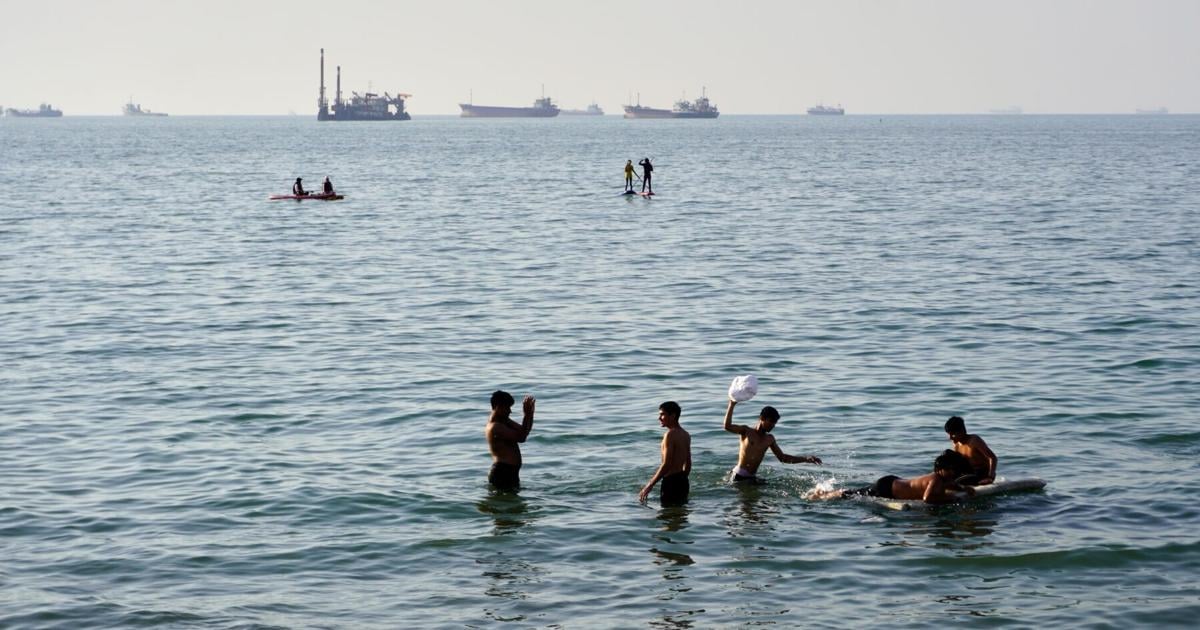
Pakistan's prime minister says the United State and Iran have agreed to wording of an agreement aimed at ending their war in the Middle East. Pakistani Prime Minister Shehbaz Sharif said in a social media post Friday that mediators are working with both sides to finalize a deal. He wrote: “Peace has never been this close.” Iran's foreign minister said both sides are working toward an initial agreement to end the war. He said terms dealing with Iran's nuclear program and other issues will be finalized during the following 60-day period. Residents swim and play in the waters of the Strait of Hormuz while cargo ships and commercial vessels lie anchored in the distance off Bandar Abbas, Iran, Wednesday, June 10, 2026. President Donald Trump is pictured during an event where he signs a proclamation about the fishing industry, in the Oval Office of the White House, Thursday, June 11, 2026, in Washington. FILE - Vice President JD Vance, left, talks to Pakistan's Chief of Defence Forces and Chief of Army Staff Field Marshall Asim Munir, right, and Pakistani Deputy Prime Minister and Foreign Minister Mohammad Ishaq Dar, center, before boarding Air Force Two after attending talks on Iran in Islamabad, Pakistan, April 12, 2026. A woman walks past an anti-American mural on the wall of the former U.S. Embassy, now a museum, in Tehran, Iran, Friday, June 12, 2026. ISLAMABAD (AP) — Pakistan’s prime minister said Friday the United States and Iran have agreed to wording of an agreement aimed at ending their war in the Middle East and that mediators were working with both sides to finalize a deal. Prime Minister Shehbaz Sharif said the U.S. and Iran have reached a “final, agreed upon text.” He said Pakistan, which has taken the lead in mediation efforts, was working with the warring countries on next steps. “Peace has never been this close as it is now,” Sharif said in a post on X. The apparent breakthrough in negotiations comes after Iran exchanged fire with the U.S. and Israel over three days this week, threatening to return the Middle East to full-scale war. Iranian Foreign Minister Abbas Araghchi said Friday an agreement “has never been closer” in post on X. U.S. President Donald Trump, who has said multiple times in recent weeks that the countries were on the cusp of a deal, shared Araghchi's post on his own social media. The war launched by the U.S. and Israel on Feb. 28 has rattled the Middle East and virtually shut down oil and natural gas shipments from the Persian Gulf. A fragile ceasefire has been in place since April 7. Araghchi told Iranian state TV on Friday that both sides were working toward signing an initial agreement declaring an end to the war. He said terms dealing with Iran’s nuclear program would be finalized in the following 60 days as they negotiate a final deal. He said the initial agreement would end the war “on all fronts, including Lebanon.” Israel has been fighting the Iranian-allied militia Hezbollah in Lebanon since early March. Israel is not a party to the negotiations between the U.S. and Iran, and its leaders have said they don't plan to withdraw from Lebanon. A senior U.S. administration official, who briefed reporters on condition of anonymity under ground rules set by the White House, said Friday that the emerging agreement would reopen the Strait of Hormuz and begin the process of destroying or removing Tehran’s highly enriched uranium. The official said the 60-day period after both sides sign the deal would be used to work out technical details for removing Iran’s enriched uranium. The official did not detail who the U.S. envisions taking charge of removing the uranium, which is believed to entombed under three nuclear sites that were battered by U.S. strikes last year. The official said a deal was 80% to 85% done and that the U.S. side believes “most of the people who have authority” in the Iranian government want to sign onto the deal “but not everybody.” Three regional officials said the emerging deal is also expected to include the phased lifting of sanctions on Iran and the release of frozen Iranian assets. The officials spoke on condition of anonymity because of the sensitivity of the negotiations. Underscoring the fragility of the negotiations, Trump on Friday lashed out at Iranian officials on social media and said: “They better get their act together, and FAST!” That was before he shared Araghchi's post declaring a deal was close. Iran's nuclear program has been a key point of division. The U.S. and Israel fear it could lead to an atomic weapon — a main reason their leaders cited for going to war. Tehran has insisted its nuclear efforts are for peaceful purposes. Also critical is Iran’s effective closure of the Strait of Hormuz, a vital shipping lane for oil and natural gas. Disruption of transit through the strait has crimped global energy supplies, driven up fuel prices and made food and other basics more expensive well beyond the region. The U.S. has responded since mid-April with a naval blockade of Iranian ports to choke off Iran’s own oil exports. The regional officials said they expect a signing ceremony for the agreement in the coming days after officials in Washington and Tehran approve it. Trump on Thursday claimed significant progress in the negotiations, just hours after he threatened to escalate attacks and seize Iran’s oil industry. Esmail Baghaei, a spokesperson for Iran’s Foreign Ministry, said on state television that mediators were active and the text of a deal was “mostly finalized.” There was no immediate comment Friday from Pakistan’s Foreign Ministry, which has been leading efforts to mediate a deal between the U.S. and Iran. Foreign Ministry spokesperson Tahir Andrabi had said Thursday that Pakistan remained involved in negotiations. Israeli Prime Minister Benjamin Netanyahu has said Israel is not a party to the deal being negotiated. He said in a statement Friday that he and Trump were in “full agreement” that Iran must not have nuclear weapons. Israeli Defense Minister Israel Katz said in a separate statement that Israel also expects Trump to uphold key Israeli interests, including weakening Iran's missile program and proxy network. Katz warned that Israel could still act independently toward Iran and that the country would not pull out of the zones it is occupying in Lebanon, Syria and Gaza, nor would it withdraw from the northern refugee camps of the Israeli-occupied West Bank. The deal was largely being brokered by Pakistan, led by its army chief Field Marshal Asim Munir, the regional officials said, with backing from Saudi Arabia, Turkey, Egypt, and Qatar. Price reported from Washington and Bynum reported from Savannah, Georgia. Associated Press journalists Julia Frankel in Jerusalem, and Collin Binkley and Aamer Madhani in Washington contributed. Copyright 2026 The Associated Press. All rights reserved. This material may not be published, broadcast, rewritten or redistributed without permission. Your comment has been submitted. There was a problem reporting this. Keep it Clean. Please avoid obscene, vulgar, lewd, racist or sexually-oriented language. PLEASE TURN OFF YOUR CAPS LOCK. Don't Threaten. Threats of harming another person will not be tolerated. Be Truthful. Don't knowingly lie about anyone or anything. Be Nice. No racism, sexism or any sort of -ism that is degrading to another person. Be Proactive. Use the 'Report' link on each comment to let us know of abusive posts. Share with Us. We'd love to hear eyewitness accounts, the history behind an article.